
Group of young happy confident diverse adult students wearing headphones studying together for a TOEIC listening exam in a bright modern library

TOEIC English Newsletter — by TOEIC Success

TOEIC English Newsletter

Issue #13  ·  October 28, 2026  ·  toeicsuccess.com

Listening More Effectively: Six Proven Strategies

Young happy confident East Asian woman student wearing headphones listening to a TOEIC listening exam practice test at a clean wooden desk, taking notes with a pencil

The TOEIC Listening paper plays each recording only once — so effectiveness matters more than effort. This issue brings six proven strategies that help you catch the right information the first time, so you finish the 45-minute paper with confidence and higher accuracy. Each strategy is demonstrated on the fresh practice questions on the following pages, where you will see exactly how to apply it under exam conditions.

Strategy 1 — Preview the Questions Before the Audio Starts

The slow way: Waiting for the audio to begin before looking at the questions, then scrambling to read and listen at the same time.

The fast, effective way: On Parts 3 and 4 you are given time to read the questions before each conversation or talk begins. Use every second of it. Read each question and underline one key noun or verb. When you know what to listen for, your ears filter the audio automatically — you will hear the answer the moment it is spoken instead of realising too late that you missed it.

  • Use the introduction time to read all three questions for a conversation or talk.
  • Underline one key word in each question stem.
  • Decide what kind of answer you need — a name, a time, a reason, a location.

Strategy 2 — Predict the Answer Type Before You Listen

The slow way: Listening passively and hoping the answer will become obvious, then choosing the option that "sounds familiar".

The fast, effective way: A question word tells you what to expect. "Who" means a person; "when" means a time or day; "where" means a place; "why" means a reason. Before the audio starts, label each question with its expected answer type. Now your brain hunts for that specific category of information, and distractors designed to sound plausible no longer fool you.

  • Mark each question with W (who), T (when), L (where), R (why/reason), or H (how).
  • Eliminate any option that does not match the predicted answer type.
  • Watch for distractors that mention the right topic but the wrong category.

Strategy 3 — Catch the First Word in Part 2

The slow way: Listening to the whole question and trying to understand every word, then choosing a response that "sounds polite".

The fast, effective way: In Part 2, the first word of the question usually decides the correct response. A "Where" question needs a place; a "When" question needs a time; a "How" question needs a method. Train your ear to lock onto that opening word in the first half-second. Even if you miss the rest of the question, the first word alone is often enough to eliminate two of the three options.

  • Identify the question word — who, what, where, when, why, how, which — in the first second.
  • Reject any response that does not answer that question type.
  • Beware of "sound-alike" distractors that repeat a word from the question but do not answer it.

Strategy 4 — Listen for Paraphrases, Not Exact Words

The slow way: Hearing a word from the question spoken in the audio and immediately choosing the option that contains that exact word.

The fast, effective way: TOEIC rarely repeats the question's wording in the audio or the answer. The correct option paraphrases what was said. If the question asks about a "delay", the audio may say "behind schedule"; the answer option may say "late". When you hear a keyword from the question, expect the actual answer to use a synonym — and treat any option that copies the audio verbatim with suspicion.

  • Think of two synonyms for each keyword before the audio begins.
  • Match meaning, not sound — the right answer rarely echoes the exact words.
  • Be suspicious of options that repeat the audio word-for-word; they are usually traps.

Strategy 5 — Take Quick Shorthand Notes for Parts 3 & 4

The slow way: Trying to hold every detail in your head through a long conversation or talk, then forgetting the first point by the time you reach the third question.

The fast, effective way: You cannot replay the audio, so write as you listen. Use abbreviations and symbols — "mtg" for meeting, "→" for "going to", numbers for times, arrows for cause and effect. You do not need full sentences; you need a few anchors you can scan when answering. Practise a personal shorthand so your hand keeps up with your ear.

  • Invent 5–10 abbreviations for common business words (mtg, qty, hr, $, →).
  • Write only facts the questions ask about — names, times, reasons, places.
  • Keep notes short: one or two words per point, never full sentences.

Strategy 6 — Move On the Moment You Miss an Answer

The slow way: Freezing on a question you did not catch, then missing the next two answers while you worry about the first.

The fast, effective way: The audio never stops for you. The instant you realise you have missed an answer, eliminate one option, guess, and refocus on the next question. One lost point is recoverable; three lost points in a row are not. Train yourself to let go instantly — a wrong guess costs nothing, but a stalled attention span costs everything that follows.

  • Set a hard rule: if you miss an answer, guess within two seconds and move on.
  • Eliminate the obviously wrong option first to raise your guess odds.
  • Refocus fully on the next question — never listen backwards in your head.
This week's challenge: Sit one full Listening practice paper with this issue open beside you. Every time you catch yourself listening passively, freezing on a missed answer, or choosing an option that copies the audio verbatim — pause and apply the matching strategy instead. At the end, compare your score to last week's.
Page 1 of 4  ·  Issue #13  ·  October 28, 2026  ·  toeicsuccess.com

Timed Activities & Parts 1–2 Practice

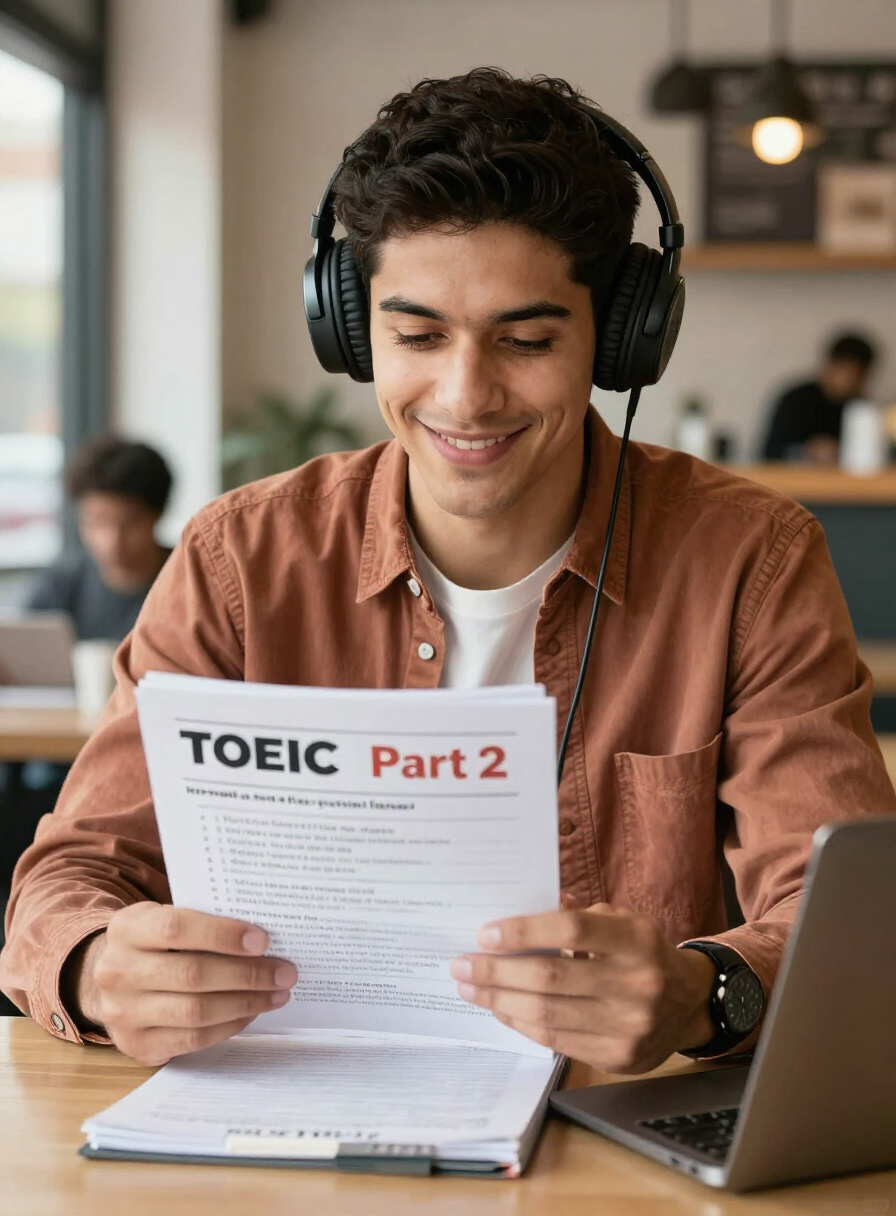
Young happy confident Hispanic man student wearing headphones concentrating on TOEIC Part 2 question-response practice questions with a notebook at a cafe table

Below are four timed activities — one for each part of the Listening paper — each wired to a specific strategy from page 1. Practise each against a real timer until the strategy feels automatic. Then try the fresh Part 1 and Part 2 questions that follow, applying the strategies as you go.

Part 1 — Photographs

Target: 6 questions in ~3 minutes

Apply Strategy 2: before each photo is described, glance at the picture and predict three things you might hear (objects, actions, locations). Listen for the one statement that is fully true — reject any option that is partially wrong. Do not choose a statement that describes only part of the picture.

Part 2 — Question-Response

Target: 25 questions in ~8 minutes

Apply Strategy 3: lock onto the first word of each question. A "Where" needs a place, a "When" needs a time. Apply Strategy 4: reject any response that repeats a word from the question but does not answer it. If unsure, eliminate the clearly wrong option and guess within two seconds (Strategy 6).

Part 3 — Conversations

Target: ~12 minutes for 13 conversations

Apply Strategy 1: read all three questions and underline keywords before the audio starts. Apply Strategy 5: jot 2–3 shorthand anchors as you listen. Apply Strategy 2: label each question with its answer type. Answer in order; if one stalls, guess and move on (Strategy 6).

Part 4 — Talks

Target: ~10 minutes for 10 talks

Apply Strategy 1: scan the three questions during the introduction. Apply Strategy 5: note the speaker's purpose and any numbers, dates, or names. Apply Strategy 4: the correct option paraphrases the talk — beware verbatim traps. Keep moving; never replay in your head.

Part 1 — Photographs (Questions 1–3)

Directions: For each question, you will see a photograph and hear four statements about it. Select the statement that best describes what is happening in the picture. Apply Strategy 2 — predict what you might hear, then choose the one statement that is fully true.

QR code for Part 1 audio

Scan to play Part 1 audio

Point your phone camera at the QR code to open the audio player and listen to these questions at authentic TOEIC exam pace, with pauses between questions.

Or open the audio player →

1. Photograph

A photograph of a woman in business attire presenting slides on a screen to a small group seated around a conference table. A projector is on, and several people are taking notes.
A. The woman is typing on a laptop.
B. The woman is giving a presentation to the group.
C. The people are leaving the conference room.
D. The projector is being unplugged.

2. Photograph

A photograph of a man in a warehouse uniform scanning a barcode on a cardboard box with a handheld scanner, with shelves of boxes behind him.
A. The man is reading a newspaper.
B. The boxes are being delivered by truck.
C. The man is scanning a box with a device.
D. The shelves are completely empty.

3. Photograph

A photograph of two people sitting at a cafe table, each holding a cup of coffee and smiling while looking at a phone screen together.
A. The people are arguing loudly.
B. The people are looking at a phone together.
C. One person is paying the bill.
D. The cups are being washed.

Part 2 — Question-Response (Questions 4–7)

Directions: For each question, you will hear a question followed by three spoken responses. The question and responses are not printed in your test book — mark A, B, or C on your answer sheet. Apply Strategy 3 — catch the first word of the question, then choose the response that answers it. Beware sound-alike distractors (Strategy 4).

QR code for Part 2 audio

Scan to play Part 2 audio

Point your phone camera at the QR code to open the audio player and listen to these questions at authentic TOEIC exam pace, with pauses between questions.

Or open the audio player →

4. Mark your answer on your answer sheet.

A
B
C

5. Mark your answer on your answer sheet.

A
B
C

6. Mark your answer on your answer sheet.

A
B
C

7. Mark your answer on your answer sheet.

A
B
C
Page 2 of 4  ·  Issue #13  ·  October 28, 2026  ·  toeicsuccess.com

Listening Practice — Parts 3 & 4

Young happy confident Black woman student wearing headphones listening carefully to a TOEIC Part 4 talk practice recording in a modern office, taking shorthand notes

Apply Strategies 1, 2, 4 & 5 — Parts 3 & 4

Read the questions first and underline keywords (Strategy 1). Label each question with its answer type — who, when, where, why (Strategy 2). Listen for paraphrases, not exact words (Strategy 4). And take quick shorthand notes as you listen (Strategy 5) so you can scan your anchors when answering.

The conversation below is between two colleagues discussing a catering proposal. Read the three questions first, then read the conversation and answer. The talk is a hotel voicemail message. Answer questions 8–13. Target: 3 minutes per set.

Part 3 — Conversation (Questions 8–10)

QR code for Part 3 audio

Scan to play Part 3 audio

Point your phone camera at the QR code to open the audio player and listen to these questions at authentic TOEIC exam pace, with pauses between questions.

Or open the audio player →

8.What is the woman concerned about?

A. The retreat has been cancelled.
B. The catering cost has increased.
C. The vendor delivered the wrong food.
D. The staff retreat date was changed.

9.Why did the vendor raise its prices?

A. Because of a new minimum-wage increase
B. Because the retreat location changed
C. Because the company ordered more food
D. Because the vendor lost a contract

10.What does the woman ask the man to do?

A. Cancel the staff retreat
B. Present the options to the department head
C. Send her the new estimates by Wednesday
D. Call the original vendor
Conversation between a man (M) and a woman (W). M: Hi Sandra, did you get a chance to review the catering proposal for the staff retreat? W: I did, but I noticed the per-person cost went up by fifteen percent since last year. That wasn't in the original budget. M: I know. The vendor raised their prices because of the new minimum-wage increase. I've already asked two other companies for quotes. W: Good. Could you send me their estimates by Wednesday? I'd like to compare them before I present the options to the department head on Thursday.

Part 4 — Talk (Questions 11–13)

QR code for Part 4 audio

Scan to play Part 4 audio

Point your phone camera at the QR code to open the audio player and listen to these questions at authentic TOEIC exam pace, with pauses between questions.

Or open the audio player →

11.Why is Patricia Gomez calling Mr. Chen?

A. To confirm a reservation he already made
B. To cancel his hotel reservation entirely
C. To inform him of a problem and offer alternatives
D. To charge his credit card for the stay

12.What problem occurred with Mr. Chen's reserved room?

A. The room was double-booked.
B. The floor needed a plumbing repair.
C. The balcony was removed.
D. The room rate was increased.

13.What must Mr. Chen do before six p.m. today?

A. Pay an additional charge for the upgrade
B. Arrive at the hotel to check in
C. Call Patricia back to choose an option
D. Cancel the reservation online
Listen to the following telephone message. "Hello, this is a message for Mr. David Chen. My name is Patricia Gomez, and I'm calling from the Riverside Hotel regarding your reservation for November twelfth. Unfortunately, the room type you booked — a king suite with a balcony — is no longer available due to an unexpected plumbing repair on that floor. We'd like to offer you a complimentary upgrade to our executive suite at no additional charge, or, if you prefer, we can move your reservation to November fifteenth at a twenty-percent discount. Please call me back at extension 3401 before six p.m. today to confirm which option you'd prefer. Thank you, and we apologise for any inconvenience."
Reminder: Question 10 is a role-reversal distractor — the woman asks the man to send estimates, but she herself will present to the department head. Question 13 tests Strategy 4: "complimentary upgrade" means "no additional charge", so option A is a trap. Read carefully before you choose.
Page 3 of 4  ·  Issue #13  ·  October 28, 2026  ·  toeicsuccess.com

Answer Key — Strategies, Traps & Explanations

Parts 1 & 2 (Questions 1–7)

1. B(Photograph — choose the statement that is fully true; reject partially-correct traps.)

Trap: Choosing A because a laptop appears in the scene — but the woman is presenting, not typing.

The photograph shows a woman standing and presenting slides to a seated group. Option B matches the main action. A is false (she is not typing), C is false (the people are seated, not leaving), and D is false (the projector is in use, not being unplugged).

2. C(Photograph — reject plausible-but-not-shown statements; trust only what you see.)

Trap: Choosing B because delivery is a plausible warehouse activity — but no truck is visible in the photo.

The photograph shows a man scanning a barcode on a box. Option C matches the action. A is false (he is not reading), B is not shown (no truck is visible), and D is false (the shelves are full). Choose only what the picture actually shows.

3. B(Photograph — the correct statement describes the central action, not a plausible context.)

Trap: Choosing C because a cafe suggests payment — but no bill or money is visible.

The photograph shows two people looking at a phone screen together over coffee. Option B matches. A is false (they are smiling, not arguing), C is not shown, and D is false (the cups are in use).

4. B(Part 2 — "Where" needs a place; reject answers about features or times.)

Trap: Choosing A because "prints" sounds related — but it describes the printer, not its location.

The question word "Where" asks for a location. Option B gives a location ("down the hall, next to the elevator"). A describes a feature of the printer; C answers "when", not "where".

5. C(Part 2 — beware sound-alike distractors that echo the question but do not answer it.)

Trap: Choosing B because "effective" sounds like "take effect" — but it answers "how", not "when".

The question word "When" asks for a time. Option C gives a time ("the first of next month"). A answers "where"; B is a sound-alike trap using "effective".

6. B(Part 2 — "How" needs a method; reject responses that merely repeat a keyword.)

Trap: Choosing A because "conference" is repeated — but it comments on the event, not the method.

The question word "How" asks for a method or means. Option B gives a method ("took the express train"). A comments on the conference quality; C answers "when".

7. A(Part 2 — "Who" needs a person; reject answers about length or deadlines.)

Trap: Choosing C because the due date seems relevant — but "Who" asks for a person, not a deadline.

The question word "Who" asks for a person. Option A names a person ("Ms. Tanaka"). B describes the report; C answers "when".

Parts 3 & 4 (Questions 8–13)

8. B(Part 3 — apply Strategy 4: the answer paraphrases "cost went up" as "cost has increased".)

Trap: Choosing D because a date (Thursday) is mentioned — but the date is for the presentation, not a change to the retreat.

The woman says "the per-person cost went up by fifteen percent". Option B paraphrases this concern. A, C, and D are not stated — D is a distractor built from the date mentioned later.

9. A(Part 3 — apply Strategy 2: "Why" needs a reason; scan your notes for the cause.)

Trap: Choosing B or C — plausible catering reasons, but never stated in the conversation.

The man says "The vendor raised their prices because of the new minimum-wage increase." Option A matches directly. B, C, and D are not mentioned.

10. C(Part 3 — apply Strategy 5: your shorthand note "send est. Wed" points straight to C.)

Trap: Choosing B because presenting is mentioned — but the woman says she will present, not the man.

The woman asks "Could you send me their estimates by Wednesday?" Option C matches. A and D are not mentioned; B is a role-reversal distractor (she, not he, will present).

11. C(Part 4 — apply Strategy 1: preview the question, then listen for the speaker's purpose in the opening lines.)

Trap: Choosing A — confirming sounds plausible for a hotel call, but the room is unavailable, not confirmed.

Patricia explains the booked room is unavailable due to a plumbing repair and offers two alternatives (an upgrade or a date change). Option C paraphrases this purpose. A is the opposite of the situation; B and D are not stated.

12. B(Part 4 — apply Strategy 4: the answer paraphrases "plumbing repair on that floor" as "the floor needed a plumbing repair".)

Trap: Choosing A — double-booking is a common hotel problem, but the stated cause is plumbing.

Patricia says the room is unavailable "due to an unexpected plumbing repair on that floor." Option B matches. A, C, and D are not stated — A is a plausible-but-absent distractor.

13. C(Part 4 — apply Strategy 2: "What must he do" needs an action; your note "call back ext 3401" gives C.)

Trap: Choosing A because an upgrade is offered — but Patricia states it is at no additional charge.

Patricia asks Mr. Chen to "call me back at extension 3401 before six p.m. today to confirm which option you'd prefer." Option C matches. A is false (the upgrade is complimentary); B and D are not mentioned.

All answers © TOEIC English Newsletter. For study use only.

Keep Practising

Listen smarter this week — every second counts.

Two quick ways to keep your TOEIC skills sharp around a busy schedule.

Cheerful young happy confident Middle Eastern woman student pointing toward the TOEIC Word of the Day link

Try today's

TOEIC Word of the Day

A new intermediate business word every day — build the vocabulary your fast listening depends on.

Friendly young happy confident South Asian man student pointing toward the TOEIC Weekly Newsletter link

Read more from the

TOEIC Weekly Newsletter

Browse every issue — Listening, Reading, Writing, and Speaking strategies with model answers.

TOEIC English Newsletter — Issue #13, October 28, 2026. Published by English Training Company. Content is for study and preparation purposes only. TOEIC® is a registered trademark of ETS. This newsletter is not affiliated with or endorsed by ETS. All exercises and answers are original works created for educational use. © 2026 English Training Company. toeicsuccess.com.

Page 4 of 4  ·  Issue #13  ·  October 28, 2026  ·  toeicsuccess.com
Two well-dressed students studying a TOEIC exam paper together at home, smiling and pointing toward the Stay Updated signup

Stay Updated

Subscribe to receive our weekly TOEIC newsletter and TOEIC tips straight to your inbox — fresh vocabulary, exam strategies, and practice resources every week.

We value your privacy

We use cookies to keep this site working, and with your permission, to measure traffic and show relevant content. You can accept all, reject optional cookies, or choose exactly which ones to allow.